
Covington Directory Collections Compared
The historical shelf is regional. A volume labeled Seattle, Puget Sound, Washington, or King County may contain useful place references, but its title alone does not prove that it enumerated rural Covington. Check the geographic section and edition instructions before recording a no-result finding.
| Collection | Years | Where held | Access |
|---|---|---|---|
| SPL digitized regional directories | Selected 1867-1940 | Seattle Room Digital Collections | Free full-text and page navigation; Covington coverage varies |
| Seattle Archives directories | Research room 1890-1990 | Seattle Municipal Archives | Research-room use; chiefly Seattle material |
| King County directories | 1878, 1885/86, 1887, 1889, 1911-1915 listed | Washington State Library | Catalog, appointment, librarian, or interlibrary route |
| South King County material | Exact annual run not verified | Washington State Library | Ask staff for a catalog-level holdings check |
| County historical records | Collection-specific | King County Archives | Appointment, lobby, phone, email, and copy order |
| Statewide digital collections | Varies by record group | Washington Digital Archives | Online name, date, place, and collection searches |
A complete publisher sequence for Covington or the Kent area was not visible in official online descriptions. Do not fill that gap with a guessed Polk run. Ask the State Library or Archives to confirm the title and coverage of a specific edition.
Covington City Directory Gaps
Covington's central directory problem is coverage, not merely access. Before incorporation in 1997, records could identify the area as unincorporated King County, a farm district, railroad stop, road corridor, township, or precinct. An index search for the city name can therefore miss a household that the printed page placed under another heading.
Directory compilers often worked in late winter or spring. A household missing from one year may have moved after canvassing, lived beyond the compiler's route, used initials, had an unlisted telephone, or occupied a street too new for that edition. The absence of a continuous Covington municipal series means each volume requires an explicit coverage note.
No verified annual municipal run, complete publisher history, or citywide reverse series was located. Label a regional directory as a proxy unless its page actually includes the Covington-area address or person. That discipline prevents a Seattle-focused collection from becoming false local evidence.
Note: Cite the edition date, page, section, geographic heading, and access source so another researcher can test the same directory finding.
Early King County Directory Years
The Washington State Library county-directory catalog lists King County volumes for 1878, 1885/86, 1887, 1889, and 1911 through 1915. These countywide snapshots are the best named early run in the research, but rural Covington inclusion must be checked book by book.
The State Library also lists South King County-area material without exposing a full annual inventory in the public text. Its onsite collections use appointment procedures during the library's closure period. A reader who cannot visit should ask a librarian to confirm title, publisher, year, geographic scope, and reproduction options, or ask whether an interlibrary route is available.
The successful capture below shows the State Library county-directories resource that anchors this holdings check.
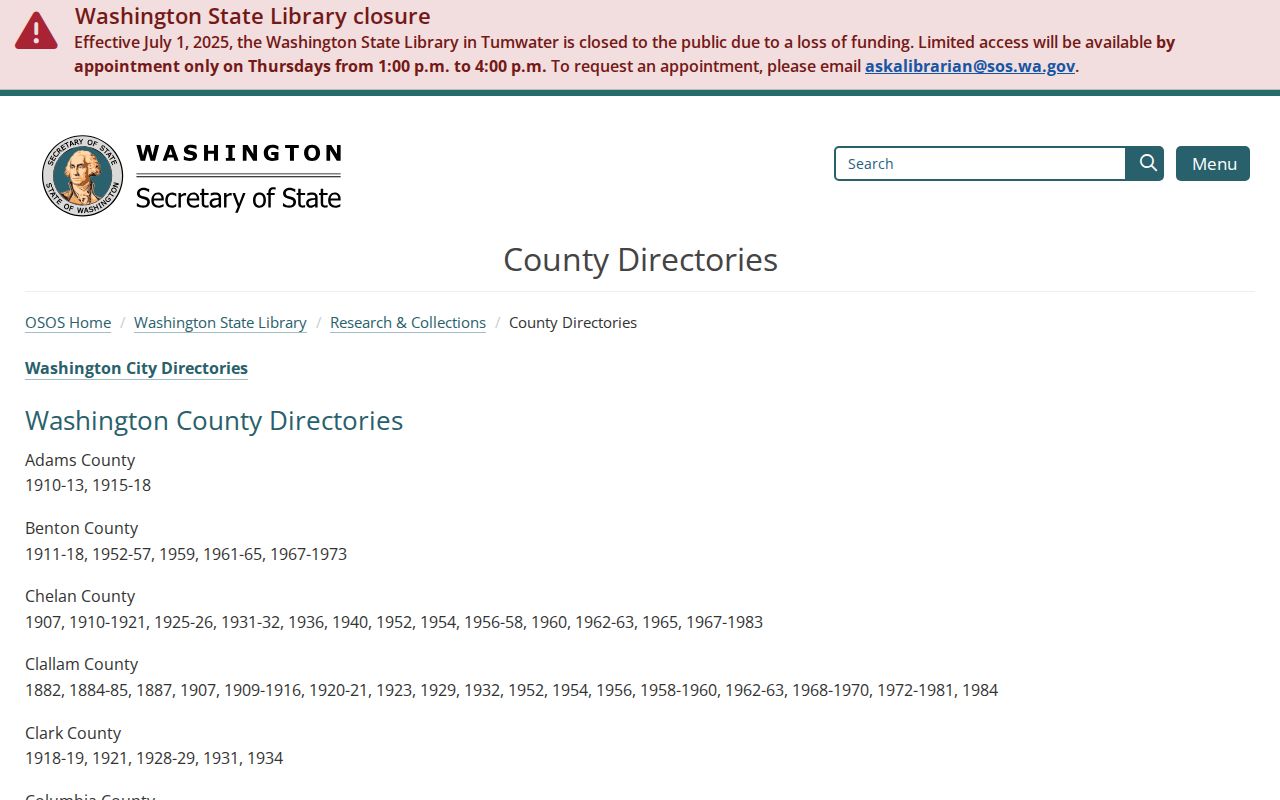
Use the listed dates as collection leads, not as proof that every Covington-area household appears in each volume.
Digitized Covington Directory Leads
Seattle Public Library's digitized city directories include selected Seattle, Puget Sound, Washington, and Pacific Coast editions from 1867 through 1940. Readers can search full text and navigate sections or page images. The collection is useful for names, businesses, and regional context, yet it remains Seattle-centered.
The 1928 Seattle House and Street Directory is the earliest reverse-directory example identified by SPL. It is arranged by address, making it a strong demonstration of how to move from a street to an occupant. Do not claim that it covers a Covington address until the page itself confirms the place.
The manifest image comes from the official SPL directory collection.
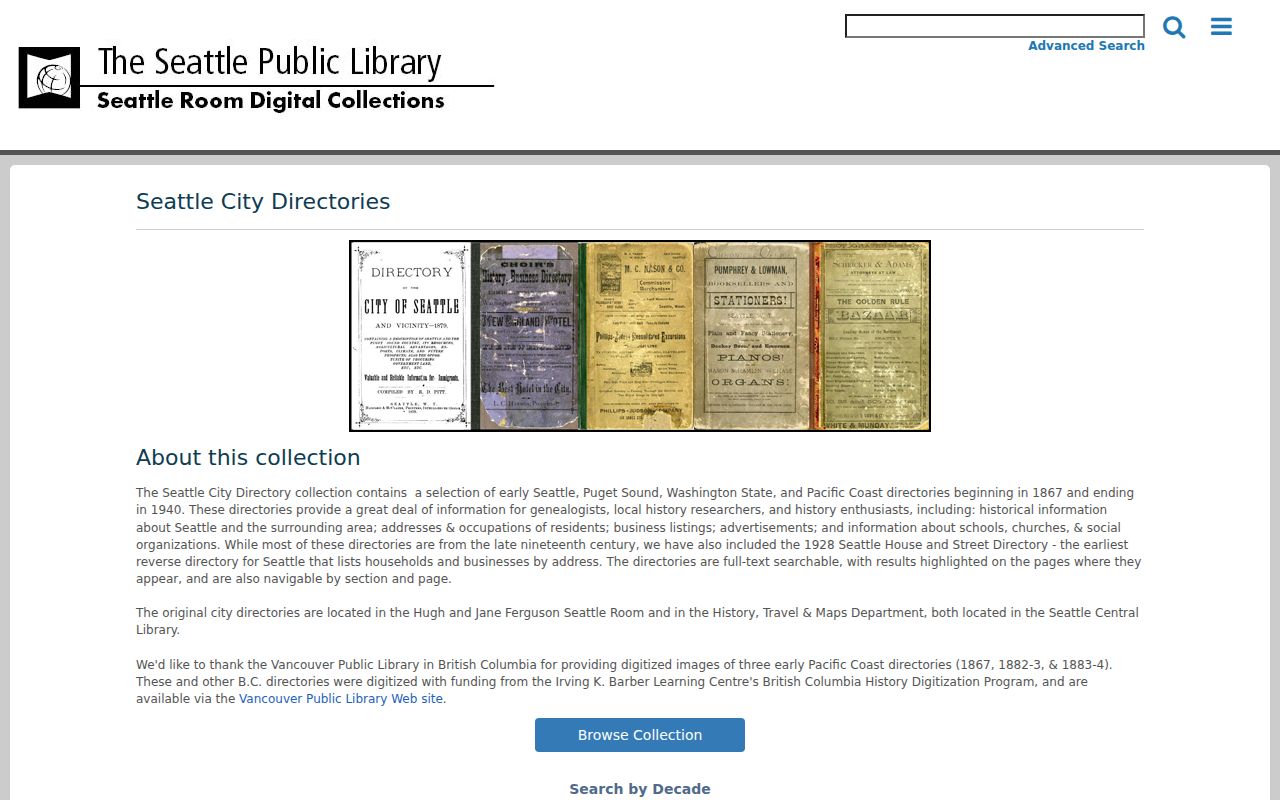
Search both a surname and an old road name, then open the scanned page. Optical text can misread initials, narrow columns, and faded type.
Read a Covington Directory Entry
No verified digitized Covington-specific sample entry was found, so no fictional resident example should stand in for one. Regional volumes can still teach the mechanics. First read that edition's key, then transcribe only what the printed line and symbols support.
| Name | Surname and given name or initials, with spelling exactly as printed |
|---|---|
| Spouse | A name or initial may appear in parentheses, depending on the edition |
| Occupation | Trade, role, or business link, sometimes in abbreviated form |
| Address | House number and street form used when the directory was compiled |
| Status mark | Possible home, residence, room, board, or widow notation defined by that volume |
| Cross-reference | A pointer between the name section and street-order section |
A directory entry is a compiler's dated report. It is not a deed, voter registration, census return, or proof of legal domicile. Preserve the image and the key page with the transcription.
- Criss-cross directory
- A section ordered by street and house number, allowing an address-to-name search.
- Householder index
- An edition's list of household names, whose exact inclusion rules must be checked.
- Abbreviation key
- The page defining shortened words and symbols for that edition.
- Proxy entry
- A regional example used to explain format, not evidence of a Covington resident.
Covington Plats Explain Missing Streets
Aqua Vista Estates was filed in 1961. Other named Covington-area plats developed from 1961 through 1980, including Suncrest Park, Timberlane Estates, Hart's Addition, Covington Homes, and Victoria Glen. A road created with one of those plats cannot appear under its later form in an earlier household volume.
The city's historic context statement says 98.55 percent of surviving residential buildings were built since 1960. Nearly 20 percent date from the 1960s, with about two-thirds of that decade's construction in 1968 and 1969. This makes plat dates, assessor cards, and maps critical companions to regional directory books.
Search the subdivision name, developer, legal lot, and old road before declaring that a household vanished. A plat date marks creation of a legal division, not completion or occupancy of every house. The modern address chain belongs in the Covington street directory workflow.
Covington Maps Beside Directories
The 2023 Covington Community Historic Context Statement cites the 1907 King County Atlas, 1912 Kroll Atlas, and 1936 Metzker Atlas. It also points to Washington State Archives, White River Valley Museum, and University of Washington Special Collections. Those maps can connect a farm, road, or plat to the place later called Covington.
Older searches should include North Road and SE 240th, Middle Road and SE 256th, South Road and SE 272nd, plus Kent-Kangley Road and SR 516. The same place can shift from rural route language to a numbered street. Preserve the historical label rather than silently converting it.
The WPA Meridian Consolidated School work in 1937 and 1940, and the BPA Covington Substation construction from 1940 to 1942, provide dated local anchors. They can help place a news item or map, but they do not prove that a person resided nearby.
Note: Use Pipe Lake, Soos Creek, Jenkins Creek, and road names as search terms, never as stand-alone proof of residence.
Covington Research Beyond the Web
When digitized text ends, move to people who can inspect a catalog, box, or book. King County Archives offers a research room by appointment, weekday customer service, Tuesday and Wednesday walk-in lobby hours, phone help, email, and copy ordering. Bring names, dates, road forms, plats, and legal descriptions.
The Covington Library is the local reference starting point, although its branch page does not confirm a licensed genealogy database or a Covington directory run. Library staff can help identify catalog terms and wider KCLS access. Washington State Library and UW Special Collections provide the stronger regional directory and map bridge.
White River Valley Museum appears in the official context bibliography for local history. Ask a focused question rather than requesting every resident: name variants, likely decade, road, farm, subdivision, or institution. Funeral-home and newspaper archives can help with obituaries, but their coverage and access rules must be checked directly.
Covington Names in Voter Cards
King County Archives holds cancelled voter-registration cards from 1935 through 1994. Cards may include a name, address, precinct, and first-registration date, but they do not state the cancellation date. Some election records remain restricted under Washington law.
These cards can bridge a gap between a historical directory and a later public record. They should not be treated as a continuous resident list. Ask Archives about the name, date range, and precinct or address, then cite the collection and the fields actually returned.
The 1935 start overlaps the later part of SPL's digitized range, while the 1994 endpoint falls just before Covington's 1997 incorporation. That makes jurisdiction labels especially important. An older card may place the voter in county geography rather than a city that did not yet exist.
Trace Covington Families by Directory
A city directory gives a dated checkpoint between census years. Build two timelines, one for the person and one for the address. That separation prevents a move, renumbering, or new plat from looking like the person's disappearance.
- Choose the newest covered directory and search the surname, initials, spouse, street, and business affiliation.
- Open the scanned page, copy the exact entry, and save the edition's abbreviation key.
- Move backward and forward one available volume at a time, recording gaps rather than filling them by guess.
- Pair the snapshots with public federal census schedules. The 1940 census is open, and 1950 became public in 2022 under the 72-year rule.
- Check plats and historical maps when the address changes, then use an obituary or probate record as a possible endpoint.
A rural Covington household may appear under a township or enumeration district in census material. A directory disappearance can mean a move, death, missed canvass, altered name, or unlisted household. Test each explanation with another dated source.
Close a Covington Directory Trail
Washington Digital Archives can extend a directory find into collection-specific land, marriage, naturalization, military, cemetery, and vital indexes. Search by the exact name, variant, date, and place. Image availability differs by collection, so distinguish an index result from the underlying record.
An obituary may supply a death date, last address, or relative. A King County Superior Court probate file may connect heirs to later property records. Court files can be sealed, redacted, or incomplete, and an obituary is not legal proof of title. Request the record from its custodian before making a firm conclusion.
Naturalization, military, census, land, and cemetery collections may also be available through NARA or other named repositories, but no collection title specific only to Covington was verified. The best final answer is often a chain of clearly cited sources, with unresolved years left visible.