
Finding Covington Residents Across Public Rolls
A useful Covington resident-record search begins by defining the question. For a current street address, King County iMap can identify the parcel and eReal can add the tax account, value, characteristics, levy, and sale-history context described by the Assessor. Landmark then connects named deed parties to recorded instruments. For one known name, court, license, business, and voter resources offer separate points of confirmation. For an older household, county indexes, directories, maps, and newspaper references become more useful than a modern portal.
No source proves every person who shares an address. An assessed owner may receive tax mail elsewhere, a deed party may never occupy the parcel, and protected voter details are withheld. Treat the Covington directory as a chain of clues whose dates and custodians must agree.
Keep a small source log as the search grows. For each result, write down the exact name, address form, parcel or instrument number, event date, office, and access date. That makes it easier to tell a current fact from an old one and to ask a clerk for the right file. When two records conflict, favor neither automatically. Check who created each record, what task it served, and whether one source simply reflects an earlier point in time.
- Normalize the full name or street address and note alternate spellings.
- Map the address in King County iMap and record the parcel number.
- Check eReal and Landmark, keeping each record date and party role.
- Use VoteWA, court, license, or archive sources only for the question each can answer.
- Request an identifiable city or county record when no online index exists.
Offices Behind the Covington Residents Directory
Covington has no county-seat records office of its own. King County offices in Seattle and Renton keep the major parcel, deed, archive, and election sources. The Assessor describes the taxable parcel. The Recorder indexes land instruments. Elections administers voter registration under Washington disclosure rules. The City Clerk keeps city-created records such as agendas, ordinances, claims, and non-police requests. For a full address-first method, use the Covington street directory guide.
Send corrections to the office that made the record. A Recorder cannot certify a court outcome, an Assessor cannot certify who occupies a home, and Archives cannot supply an entry that a directory never printed. This office-by-office split is central to sound King County research.
King County Recorder
201 S Jackson St, Suite 204
Seattle, WA 98104
206-477-6620
Covington Resident-Record Keys in eReal and iMap
King County splits mapping from the property card. In iMap, Basic Search accepts an address, a parcel number, a place, or an intersection written with an ampersand. A selected match outlines the parcel in red; layers and basemaps can then show nearby lots, districts, zoning, aerial imagery, vintage aerials, and terrain context. The parcel number is the stable bridge into eReal and recorded documents.
| Portal key | Confirmed use | Research caution |
|---|---|---|
| Street address | iMap Basic Search | Shows parcel geometry, not all occupants |
| Intersection | iMap with street & street | Use to orient a block |
| Property tax account | eReal entry search | Record labels vary by parcel |
| 10-digit parcel number | eReal entry search | Best link across county systems |
| Owner name | Not verified on the current eReal entry screen | Do not promise this field |
Four record words. A roll is an official list made for a defined task. An index is a finding aid that may not include the image. A parcel is a mapped legal unit of land. A criss-cross directory is a volume arranged by address instead of surname.
Landmark's Split Coverage for Covington Resident Records
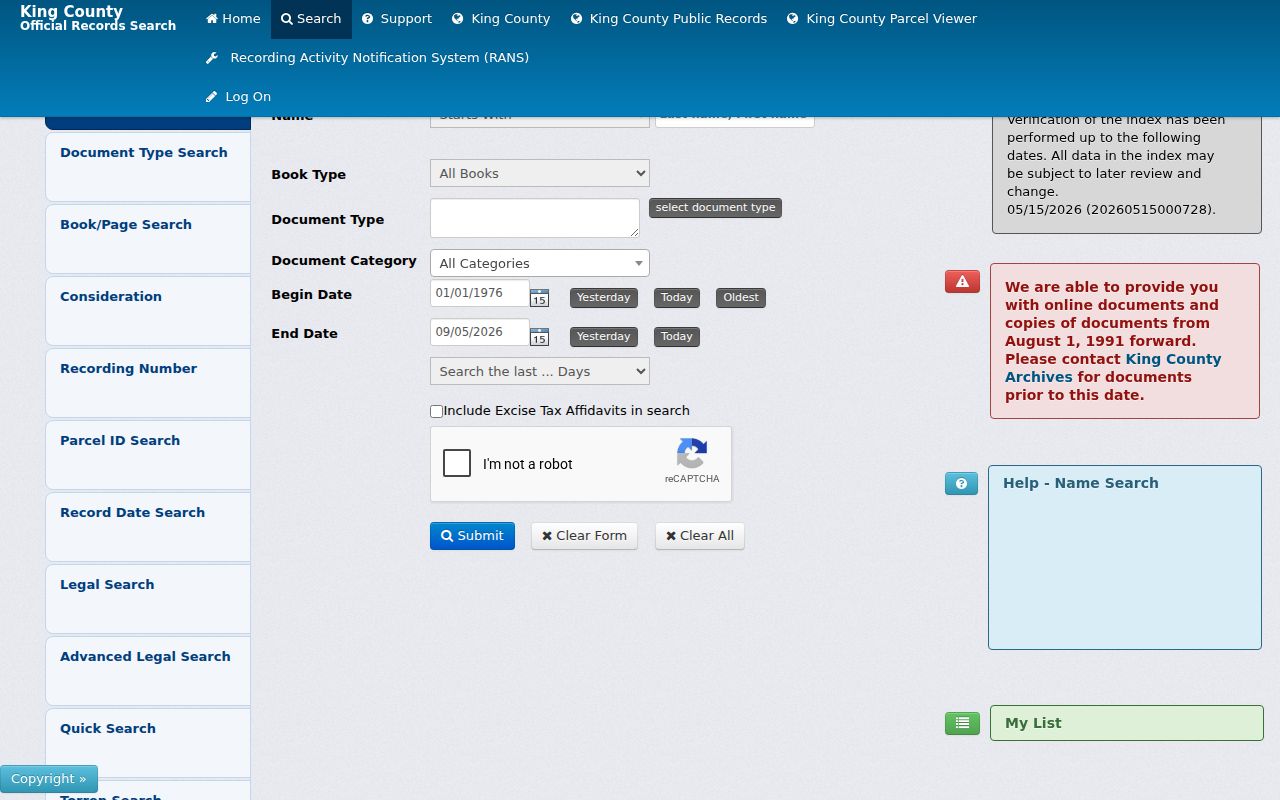
The Landmark index reaches from 1976 to the present, but most document images begin August 1, 1991. Parcel indexing was also inconsistent until roughly 2002. A blank parcel search is therefore not proof that an instrument does not exist. Retry with the full grantor or grantee name, a date window, document type, and legal description.
King County Archives holds the earlier route. Its recorded-document custody spans 1852 through July 31, 1991, while the onsite General Recordings Index covers 1853 through 1975. Researchers can email or phone Archives, visit its lobby on Tuesday or Wednesday, or arrange a research-room appointment. Recorder copies may be ordered online or by mail; a certified online copy is mailed after purchase. The split between an online index and an online image is one of the most important Covington resident-search limits.
See the live King County Landmark search screen before setting search terms.
Covington Resident Records Start With an Identifiable Request
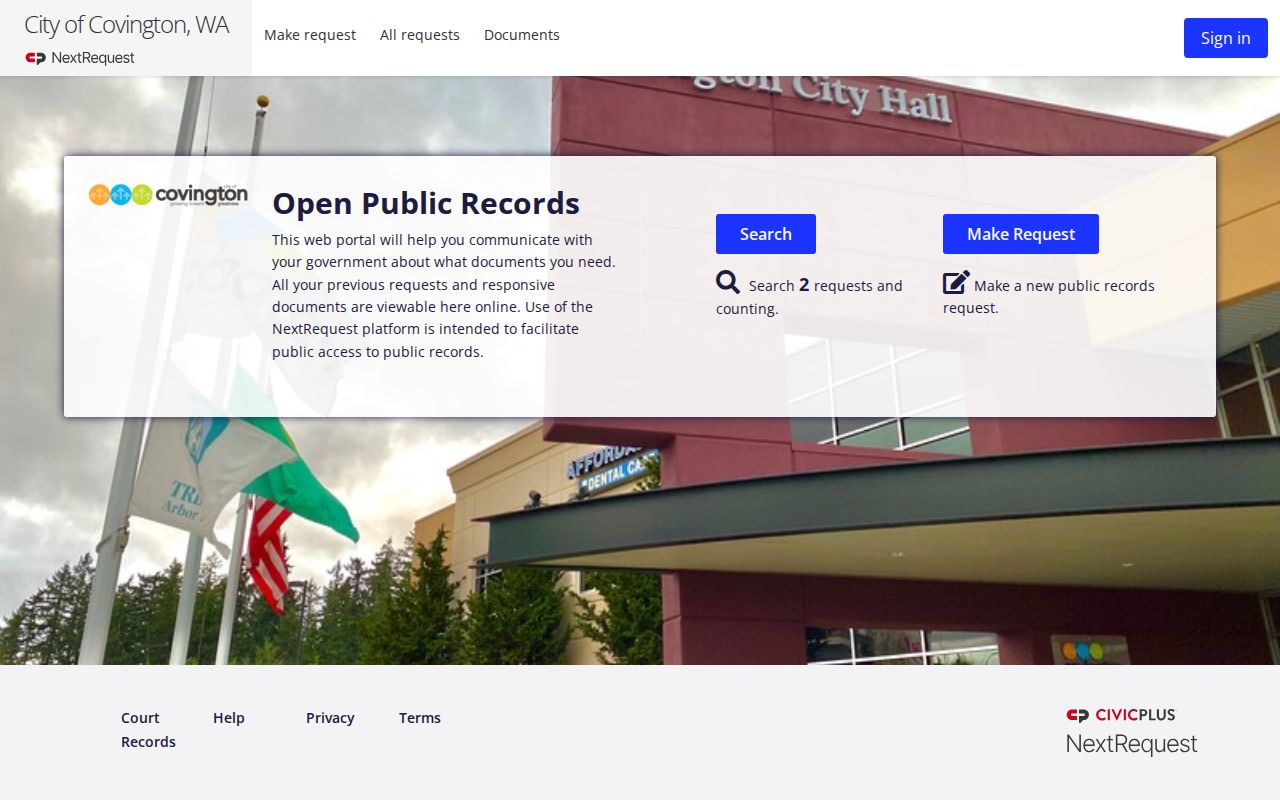
The city publishes agendas, minutes, ordinances, resolutions, interlocal agreements, and some permit tools, but it does not publish a resident roster. Use the Covington NextRequest portal or the printable City Clerk form for a record the city already holds. Give the department, date range, address, parcel, permit number, and subject. Under chapter 42.56 RCW, the agency need not create a list or answer a research question.
Within five business days, the city must provide records, point to them, acknowledge the request with an estimate, seek clarification, or deny it with an exemption. Inspection is free. The city may charge allowed copy and mailing costs, including up to $0.15 per paper page when calculating actual cost would be too burdensome. Police and accident records are a distinct exception: Covington contracts with the King County Sheriff's Office and says it neither holds nor copies those files.
The city request portal shows the correct intake point for non-police municipal files.
Current Sources for Covington Residents
Today's directory-like sources are purpose-built rolls. Their scope matters more than the number of names returned. A parcel record focuses on an assessed owner; a voter record follows election law; a filing follows an entity; and a permit follows work at a site. Combine them only when the dates, names, and addresses align.
| Covington source | People or parties covered | Official custodian | How to reach it |
|---|---|---|---|
| eReal property roll | Assessed owners and parcel facts | King County Assessor | Free account or parcel lookup |
| VoteWA voter tools | A person's own registration; lawful file fields by request | King County Elections and Washington SOS | Online tool or records request |
| Landmark recorded-document index | Named parties to deeds, liens, plats, and related instruments | King County Recorder | Free index; copies may cost |
| PermitTrax and city files | Applicants and contacts tied to a site, when disclosable | City of Covington | Portal, appointment, or request |
| CCFS business filings | Business entities and filing parties | Washington Secretary of State | Free corporation search |
Start with the roll built for the question, then verify with an unrelated source. If the task centers on one name instead of a parcel, the Covington resident lookup workflow explains the court, vital, license, and filing routes without treating any one hit as identity proof.
Covington Resident Rolls Have a Narrow Voter-Record Purpose
King County Elections links to Washington voter-information tools and accepts requests through its Renton office, email, fax, or mail channels. Public voter-file fields are governed by RCW 29A.08.710 through .740. Social Security numbers, full birth dates, and driver or state identification numbers are excluded. Address Confidentiality Program participants and other protected voters are withheld.
Voting history indicates participation, never the choice marked on a ballot. The My Voter Information route is chiefly a self-service check. A broader file request carries statutory use certification and is not a casual household search. Historical work follows a different path: King County Archives has cancelled voter-registration cards for 1935 through 1994, but the cards do not state the cancellation date. Match an old card to directories, deeds, and census geography before drawing a conclusion.
Use records lawfully. Public access supports personal research and civic transparency. Never use a name or address to stalk, harass, intimidate, or harm someone.
Official Covington Residents Directory Rolls Versus Commercial Indexes
Official sources are narrower but easier to audit. Each record has a creator, date, statutory purpose, and correction channel. A commercial people-finder may blend stale addresses, unrelated names, and inferred relatives without explaining the underlying record. It can offer a lead, but it cannot certify ownership, voter status, a court result, or a vital event.
Official record trail
Usually free to search, tied to a named custodian, and limited to a defined government task. Copies, certifications, or archive research may carry fees.
Compiled commercial index
May combine many sources quickly, but dates and matching logic can be unclear. Verify every useful clue with the office that created the record.
The strongest Covington directory method records the search date, spelling, role, and portal used. That habit makes conflicts visible and prevents an old deed address from being mistaken for a current home.
Why Covington's 1997 Incorporation Changes a Search
Covington incorporated on August 31, 1997, after a November 1996 vote. Earlier records may describe the same land as unincorporated King County, a rural community, a railroad stop, a precinct, or a road corridor. A pre-city search should therefore include Kent, Lake Meridian, Black Diamond Road, and the older road names that became familiar numbered routes.
SE 240th, SE 256th, and SE 272nd preserve links to North, Middle, and South Roads. Kent-Kangley Road and SR 516 add another modern label. Plats such as Aqua Vista Estates, Suncrest Park, Timberlane Estates, and Hart's Addition can be more stable than the city name. This is a records story as much as a civic one: the same household can be indexed under different place labels without having moved.
Covington Resident Records Gain Context From Permit Files
PermitTrax and Citizens Connect can help follow work at a specific Covington site, while the City Clerk can route an identifiable permit or code file that is not publicly searchable. Permit applications may show an applicant, contact, site address, inspection event, plan, or status where disclosure rules allow. Those names describe roles in a project and do not, by themselves, establish who occupied the site.
For direct help, Covington Permit Services accepts appointments Monday through Thursday from 8 a.m. to 5 p.m. at 253-480-2449; walk-ins are not guaranteed, and voicemail is normally returned in two to three business days. Inspection requests received by 3 p.m. are scheduled for the following business day, Monday through Thursday. Pair a permit with the parcel, deed, and date rather than treating it as a stand-alone directory entry.
Historical Sources for a Covington Residents Directory
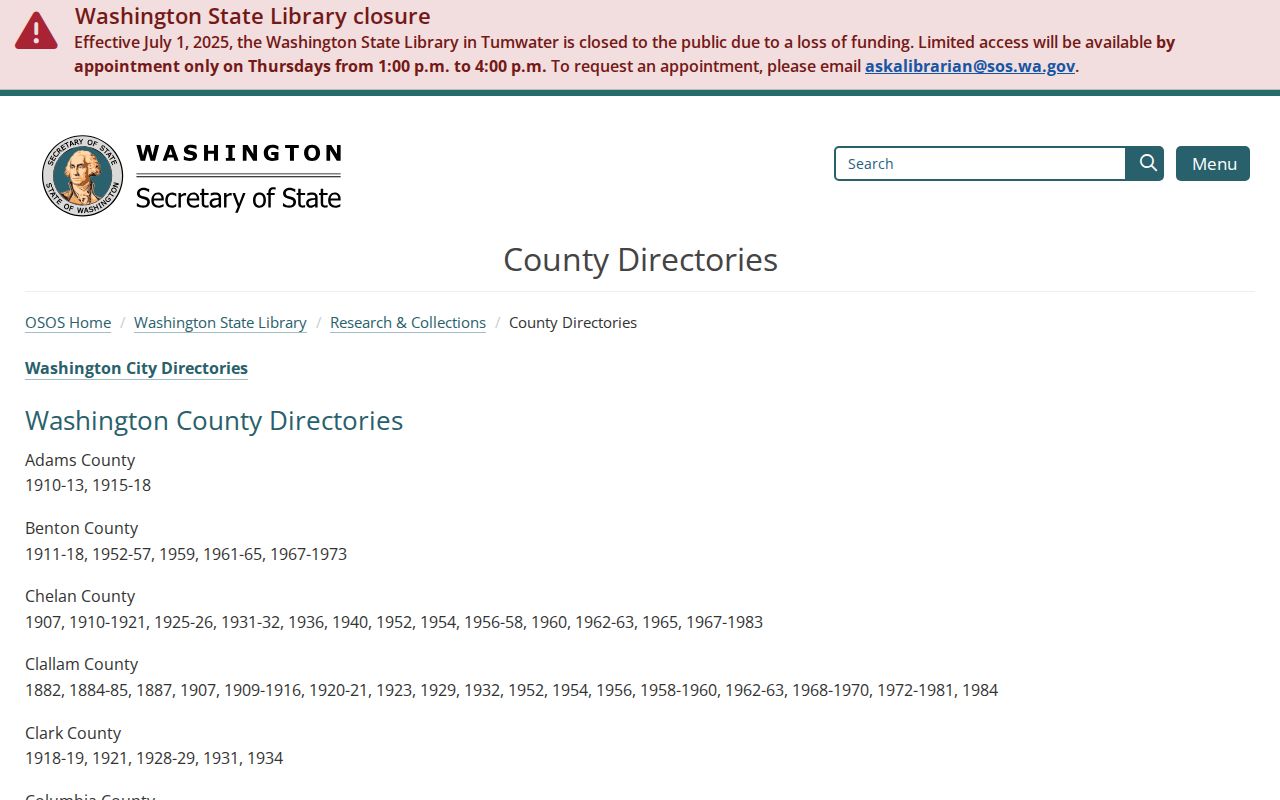
No continuous Covington city directory run was verified. The Washington State Library lists King County directories for 1878, 1885/86, 1887, 1889, and 1911 through 1915. Seattle Public Library offers a selected digitized Puget Sound and Washington run from 1867 through 1940, while Seattle City Archives has Seattle directories from 1890 through 1990. Each volume must be checked for actual Covington-area coverage.
Covington Library at 27100 164th Avenue SE is the best local starting desk for catalog help, database guidance, and interlibrary loan, but its branch page does not claim a specific directory or microfilm run. King County Archives, Washington State Archives' Puget Sound branch, White River Valley Museum, and UW Special Collections can bridge older rural years through maps, assessor cards, plats, and county records.
A directory entry may connect a name, spouse, occupation, and street for one publication year. It is a dated clue, not proof of continuous residence. The dedicated Covington city directory page explains how to read regional volumes and pair them with census years.
Open the Washington State Library county directory catalog to verify access arrangements before a visit.
Covington's Post-1960 Record Trail
The city's 2023 historic context study reports that 98.55 percent of extant residential buildings were constructed since 1960. Nearly one fifth date to the 1960s, with about two thirds of that decade's building in 1968 and 1969. That pattern explains why a Covington resident search often succeeds first in plats, property cards, permits, aerials, and deed records rather than in an old standalone municipal directory.
Aqua Vista Estates was filed in 1961, and later plats include Timberlane Estates, Covington Homes, Crystal View, Fir Manor, and Shadow Glen. A plat date marks the legal creation of lots, not the completion of every house. Check the assessment card, first deed, later permits, and directory or newspaper evidence on their own timelines. The combined trail can show when an address became usable and when a named party first appears, without overstating who lived there.
The same approach helps with the much older rural record. County maps and property cards can place a farm, school, creek, or road before a house number appears. Newspapers such as the Kent News-Journal, Seattle Times, Seattle Post-Intelligencer, and White River Journal may add a dated notice or obituary, subject to the archive's access terms. Pipe Lake, Soos Creek, Jenkins Creek, SR 18, and SE 272nd are good search anchors, but none proves residence on its own. The Covington directory remains strongest when geography, date, name, and record role all converge.