
Covington Previous Residents by Era
No source lists every person tied to a Covington address. The parcel card gives the legal starting point, recorded deeds document owners and transfers, and directories or census records may add occupants. Maps, plats, permits, newspapers, and probate files explain gaps. Pick the source that fits the year and the question.
| Address source | Years covered | Where held | What it can show |
|---|---|---|---|
| Landmark index | 1976 to present; most images from August 1, 1991 | King County Recorder | Parties, instrument type, date, number, and available image |
| General Recordings Index | 1853 through 1975 | King County Archives | Older deeds, plats, easements, liens, and legal descriptions |
| Regional directories | Selected county runs from 1878; selected regional volumes from 1867 to 1940 | State Library and Seattle Public Library | Dated names, addresses, trades, and business ties where the area appears |
| Parcel cards, plats, maps, permits | Varies by collection; most extant homes postdate 1960 | Assessor, city, and archives | Lot creation, buildings, address context, and work history |
Begin close to the target date. Use current parcel and deed systems for a recent transfer. An early subdivision needs a plat and archival assessor card. When a past resident falls in a directory gap, try census geography, newspapers, probate, and regional archives. No web result does not mean no record exists.
Access is not limited to online tools. The Recorder takes questions by phone and accepts mail copy requests with its recorded-document form. King County Archives can help by email, at its walk-in lobby, or in the research room by appointment. Covington's Permit Center offers online service and appointments, while the library reference desk can help locate regional material or arrange an interlibrary loan. Keeping those routes in the worksheet prevents a portal outage or coverage cutoff from ending the search.
Start With Covington Resident Parcels
King County eReal Property accepts a property-tax account or ten-digit parcel number. The public screen did not show a dependable owner-name search. Record the parcel number, situs address, mailing address, legal description, and sale details. Situs means the property's physical location. A mailing address is where tax notices go and may point somewhere else.
Confirm the shape and roads in King County iMap. Then match the legal description to the deed. Older documents may not carry today's parcel number. Landmark parcel indexing was inconsistent until about 2002, so party names, recording dates, and legal wording can recover a failed search for past occupants.
Walk Back Covington Past Resident Deeds
The Landmark Records Search is the main online index for a Covington deed chain. Find the newest acquisition deed for the current owner. The seller is usually the prior owner. Search that seller as an earlier grantee, the party who received title, and match the legal description before moving back again.
- Copy the current parcel number, owner, and legal description from the assessor record.
- Find the owner's purchase deed and save the recording number and date.
- Search the seller as a grantee, using dates and legal wording to reject false matches.
- Repeat until the online index no longer supplies the needed link.
- Ask Archives for the older index, microfilm, or copy route.
- Grantor
- The party transferring an interest.
- Grantee
- The party receiving that interest.
- Chain of title
- The linked series of recorded transfers for the same land.
- Legal description
- Lot, plat, or survey words that follow land despite an address change.
The Recorder's guidance explains search and copy channels. Recorder staff can help by phone. King County Archives offers older holdings and an appointment-based research room.
Covington Past Resident Records Cross a Digital Line
An online index and an online image are different. King County indexes recorded documents from 1976 forward, while most images start August 1, 1991. An earlier index hit may need a copy order. A search before 1976 moves to the General Recordings Index, deed books, or microfilm.
Keep the exact query and result. If the current parcel number fails, retry with each owner's full name, a narrower date, and the legal description. A missing image marks an access limit, not a broken chain. The Archives recorded-documents page explains custody and contact routes.
The King County Archives recorded-documents resource is the source shown below.
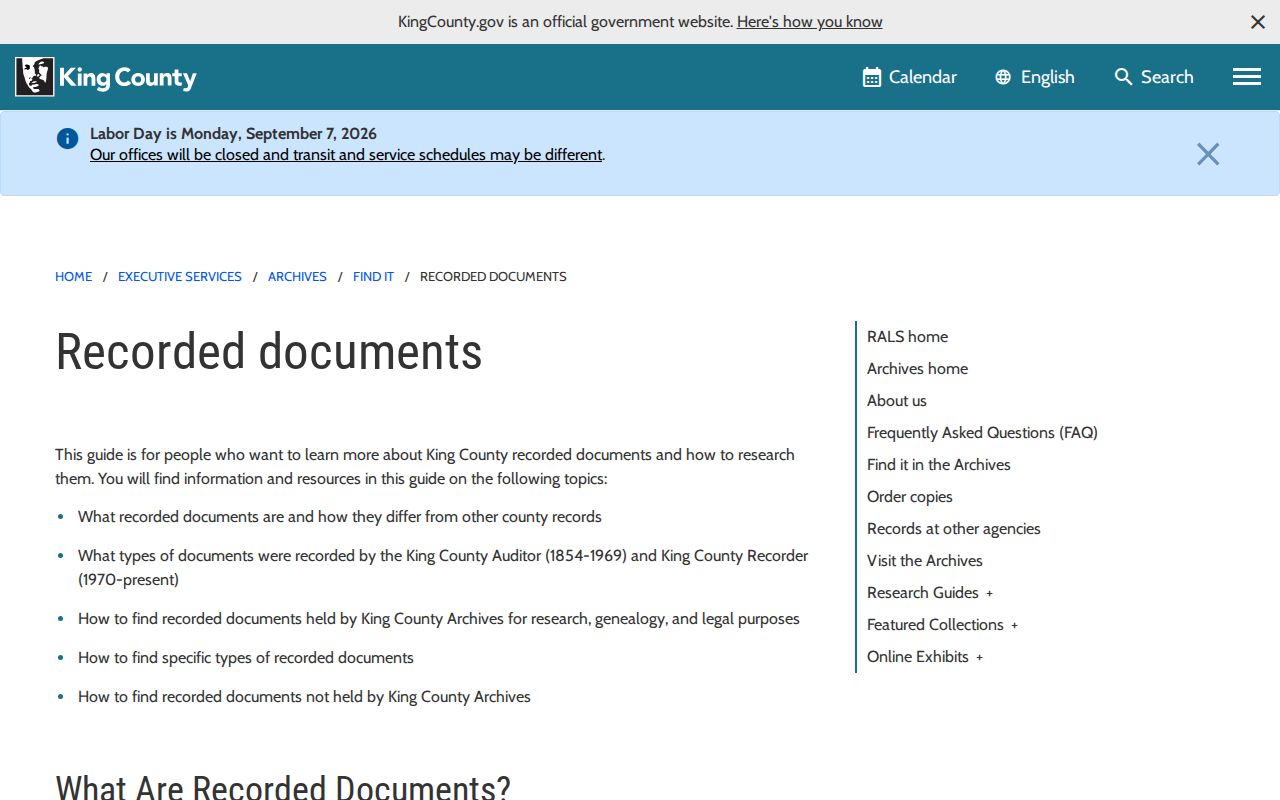
Save the recording number and date before contacting staff. Those details make a copy or microfilm request much more precise.
Covington Plats Date Past Residents
Covington's residential buildings are young: the historic context found 98.55 percent of extant homes were built since 1960. Aqua Vista Estates was filed in 1961 with 107 lots and a Pipe Lake beach. Later plats include Timberlane Estates, Hart's Addition, Meridian Court, Shadow Glen, and Victoria Glen. These names can be better search keys than a later street label.
A plat date is not a move-in date. It tells when a legal lot appeared. A building and its first household may follow later. Compare the plat, assessment card, permit trail, and first dated directory or census evidence before naming previous residents. The Covington Community Historic Context Statement points to property cards, maps, White River Valley Museum, UW Special Collections, and state and county archives.
Old Covington Resident Addresses Shift
Covington incorporated on August 31, 1997. Earlier sources may say unincorporated King County, Kent, Lake Meridian, a precinct, a road corridor, or a plat. North, Middle, and South roads connect with corridors now tied to SE 240th, SE 256th, and SE 272nd. Kent-Kangley Road and SR 516 are useful bridges between old and new descriptions.
No verified citywide renumbering list was located. Do not force an old house number into a modern scheme. Compare legal descriptions, section-township-range references, plats, county maps, and the 1907, 1912, and 1936 atlases named in the research. Current permits are available through Covington Permit Services, including online and appointment channels.
Pair Covington Household Records
Deeds identify owners, not all occupants. Regional directories may add a dated name and address, but no continuous Covington series was verified. The State Library county-directory catalog lists early county runs. Seattle Public Library provides selected regional volumes. Check each one's geographic reach.
Pair a directory entry with the nearest released census schedule, then test the road, plat, occupation, household members, and nearby names. Covington Library can help with interlibrary loan, South King County newspapers, yearbooks, and local-history books. The Covington city directory collections cover those regional shelves in depth.
A useful flow is directory entry to census household, then parcel or deed, then newspaper or obituary, and probate if needed. No single official Covington obituary index was found, so use library newspaper holdings and the proper court custodian. Each source should confirm, not merely repeat, the name.
Do not skip the years between those sources. A directory may show one adult at a street address while the census records a full household under an older place label. A deed can add the owner's legal role but still omit other occupants. Write each finding on its own dated line, including spelling variants and the repository that supplied it. If a name vanishes, check nearby streets, the same plat, an obituary, and the Superior Court probate route before assuming the person left the area.
Fixed Dates Test Covington Resident Stories
Local events can test a vague account. Meridian Consolidated School had WPA work in 1937 and 1940. The BPA Covington Substation was built from 1940 to 1942, with power flowing in March 1942. Johnny's Food Center opened in 1961 and merged with QFC in 1994. These dates can place a newspaper item, work address, or recalled landmark.
They do not prove residence. Pair an event with a named road, parcel, directory entry, census household, or deed. That step keeps a colorful family story from turning into an unsupported identity.
The city's population grew from 17,575 in 2010 to 20,777 in 2020, while its 2025 estimate reached 21,496. Those citywide counts are context, not lookup fields. They help explain why a single annual print directory would be a poor model for modern Covington and why today's evidence is split among parcel, voter, permit, court, and other custodians.
Construction dates offer another check. The context statement says nearly all extant residential buildings were built after 1960, so an alleged household at a modern subdivision address before that decade deserves close review. The person may have lived on the land under a farm or road description, but the present house number and structure may not yet have existed. Archival assessor cards, aerial photographs, and the filed plat can separate the history of the ground from the history of the building.
Use Covington Previous Residents Lawfully
House and family research can touch living people. Washington's Address Confidentiality Program gives qualifying participants a substitute address and mail forwarding. Voter and marriage information may be shielded. Sealed court files and restricted vital records remain private.
Verify facts with the custodian and avoid sharing sensitive details just because an index returned a name. Records can be stale, misspelled, or tied to a mailing address instead of a home.
Lawful use. Trace previous residents for family history, property history, and personal research. Never use an address trail to watch, threaten, or harass anyone.